Henna and indigo: how plant hair colour works
The chemistry of henna and indigo, how they combine to give brown and black shades, and why "black henna" is a warning sign.
2 min read · Updated 2026-11-14
A dye older than chemistry
Before synthetic oxidative dyes, people coloured hair with plants. A paper in the Journal of Cosmetic Science describes a permanent, grey-covering, non-fading hair colour technology based on henna, partly fermented indigo, cassia and fruit acids, which fell out of salons when synthetic dyes arrived.
How henna colours hair
Henna (Lawsonia inermis), mehendi in Hindi, contains lawsone, a red-orange molecule. Laboratory testing of henna leaf powder generally shows 0.5 to 3% lawsone. When henna paste sits on hair, lawsone migrates into the cuticle and binds to keratin, staining it. The longer the paste stays moist, the more lawsone binds; about six hours generally gives maximum uptake, and warmth speeds it up.
Pure henna therefore always gives warm tones, from orange to deep red, depending on your starting colour.
Indigo, cassia and the full range
Indigo (Indigofera tinctoria, neelpatti) adds blue-black. Cassia adds little colour but conditions. In varying proportions, the journal paper notes, henna, indigo and cassia can produce the full range of natural hair colours.
| Combination | Typical result |
|---|---|
| Henna alone | Orange to deep red |
| Henna, then indigo | Brown to black |
| Henna and indigo mixed | Chestnut to dark brown |
| Cassia | Mainly conditioning, very little colour |
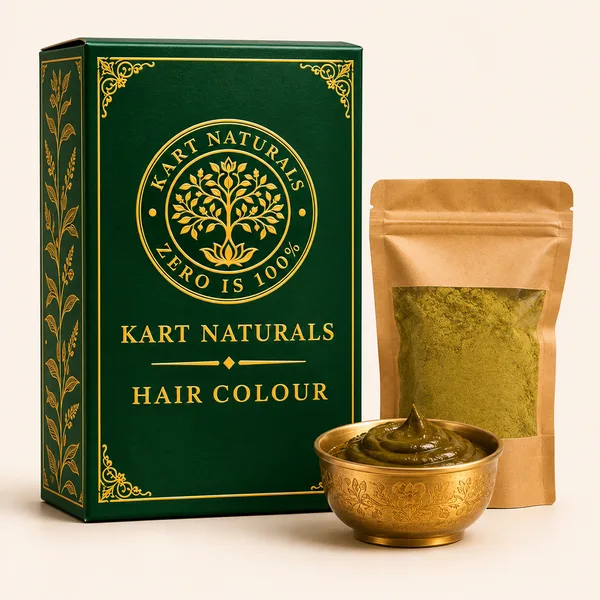
Kart Naturals' natural hair colour kits combine mehendi and indigo with katha, coffee, brahmi, shikakai and rhubarb to reach their shades.
The black henna warning
"Black henna" does not exist in nature. It is usually henna mixed with para-phenylenediamine (PPD), a synthetic dye found in most permanent hair colours. A full review in Contact Dermatitis estimates that black henna tattoos induce PPD allergy at a rate of about 2.5%, and once sensitised, people can react severely to PPD hair dyes. Red henna, by contrast, appears generally safe, with only rare allergic reactions.
Patch testing
Dermatologists consider the patch test the gold standard for detecting hair dye allergy. Apply a little prepared colour behind the ear or on the inner elbow and wait 48 hours before full use, even with plant dyes.
Children
The same review warns that in children with glucose-6-phosphate dehydrogenase (G6PD) deficiency, henna on the skin can cause life-threatening haemolysis. Do not use henna on babies or young children without medical advice.
Questions
Can henna alone colour hair black?
No. Pure henna gives red to copper tones. Black and dark brown come from combining it with indigo.
What is black henna?
Usually henna mixed with para-phenylenediamine (PPD), a synthetic dye. Black henna tattoos are estimated to cause PPD allergy in about 2.5% of applications.
Is henna safe for children?
Not always. A major review warns that in children with G6PD deficiency, henna applied to the skin can cause life-threatening haemolysis. Ask a doctor before using henna on a child.
Sources
- Kazandjieva J, Grozdev I, Tsankov N. Side-effects of henna and semi-permanent 'black henna' tattoos: a full review. Contact Dermatitis 2013;69(1):1-25
- Mukkanna KS, Stone NM, Ingram JR. Para-phenylenediamine allergy: current perspectives on diagnosis and management. J Asthma Allergy 2017;10:9-15
- Why henna disappeared from cosmetology practice. J Cosmet Sci 2017;68(1)
This guide is general information about traditional and natural care. It is not medical advice. For a skin, scalp or health condition, speak to a dermatologist or qualified practitioner.