Abhyanga: the Ayurvedic self-massage
What abhyanga is, how to do it at home in fifteen minutes, and what a small modern study found.
2 min read · Updated 2026-11-14

To anoint
Abhyanga combines abhi and anjana, meaning to smear or anoint. Ayurvedic reviews define it as massaging the whole body, including the head, with oil, and place it first among the procedures of the daily routine, dinacharya. Vagbhata, author of the Ashtanga Hridaya, calls the oil bath the best thing for the skin.
Why oil, and why every day
In Ayurvedic thinking, touch and sensation belong to vata, and oil calms vata. Classical descriptions credit regular abhyanga with keeping the body supple, strong and resilient. Modern reviews add the more familiar language of circulation and relaxation. Abhyanga is also used as preparation before deeper Panchakarma therapies.
What a modern pilot study found
Researchers at Stanford ran a small pilot study with about fifty participants split into three groups: daily self-abhyanga with an Ayurvedic herbal oil, professional massage twice a week with the same oil, and no massage. Both massage groups improved more than the control group, and the authors concluded that 30 minutes of daily self-abhyanga gave results similar to twice-weekly professional massage. It was a pilot, not a definitive trial, and the authors called for larger studies.
A fifteen-minute home abhyanga
- Warm the oil. Stand the bottle in a bowl of hot water for a few minutes.
- Start at the head. Massage a little oil into the scalp with fingertips.
- Face and ears. Light circles on the temples, jaw and ears.
- Long strokes on the limbs. Move from shoulder to wrist and hip to ankle.
- Circles on the joints. Slow circles over shoulders, elbows, knees and ankles.
- Clockwise on the abdomen. Gentle, broad circles.
- Feet last. Take time over the soles.
- Rest, then bathe. Leave the oil on for 10 to 15 minutes, then wash with warm water and a mild cleanser.
Choosing an oil
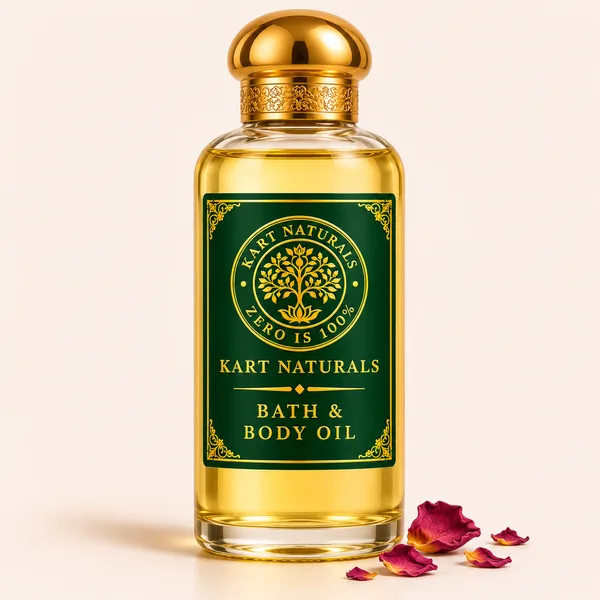
Texts match the oil to constitution and season. At home, a body oil that suits your skin is enough. Kart Naturals' Rendezvous bath and body oil, made with patchouli, lavender, manjistha and vetiver, is designed for this kind of ritual.
When to skip it
Do not massage over broken, inflamed or infected skin, and check with a doctor if you are pregnant or have a medical condition.
Questions
Which oil should I use for abhyanga?
Ayurveda adapts the oil to the person and season: warming oils such as sesame in cold weather, lighter or cooling ones in heat. Any skin-friendly body oil works for a home ritual.
How often should I do abhyanga?
Classical texts recommend daily. Once or twice a week is a realistic start.
When should I avoid oil massage?
Avoid it on broken, inflamed or infected skin, and check with a doctor if you have a medical condition or are pregnant.
Sources
- Sangwan P. Abhyanga: a conceptualized study. International Ayurvedic Medical Journal 2018;6(11)
- Kaushal S, Lohith BA, Ashvini MK. Abhyanga: different contemporary massage technique and its importance in Ayurveda. J Ayurveda Integr Med Sci 2017;2(3)
- Stanford Center for Asian Health Research and Education. Abhyanga pilot study poster
This guide is general information about traditional and natural care. It is not medical advice. For a skin, scalp or health condition, speak to a dermatologist or qualified practitioner.